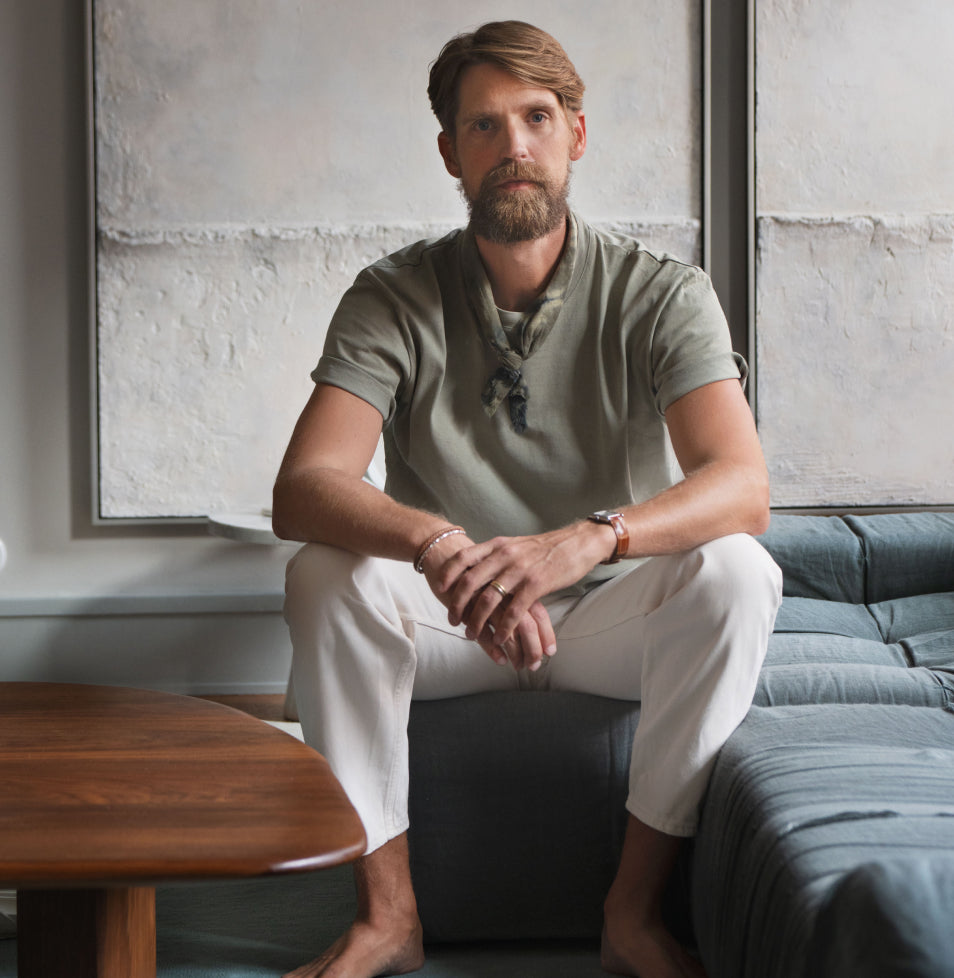
MEET THE ARTIST ERIK BRATSBERG
Erik Bratsberg is an artist and designer working across the fields of art, interiors, and spatial design. With a background in economics and a decade spent in finance, he has since developed an intuitive, material-driven practice where geometry, organic form, and color converge in carefully balanced compositions.
His work spans from objects and furniture to complete environments, guided by a desire to create beauty, function, and depth within everyday spaces. Erik Bratsberg lives and works in Sweden.
“I’ve always been drawn to sculptural forms that feel instinctively right rather than perfectly symmetrical. When the lines fall into place, something happens immediately—a kind of harmonious balance you can’t calculate.”
For those who are not familiar with your work. How would you describe yourself?
I’m an artist, designer and interior designer. Within those field I’m self taught. My formal education was within business and economics and I spent 10 years in finance before realising I had a inner drive to design and create objects and environments.
How would you describe your work?
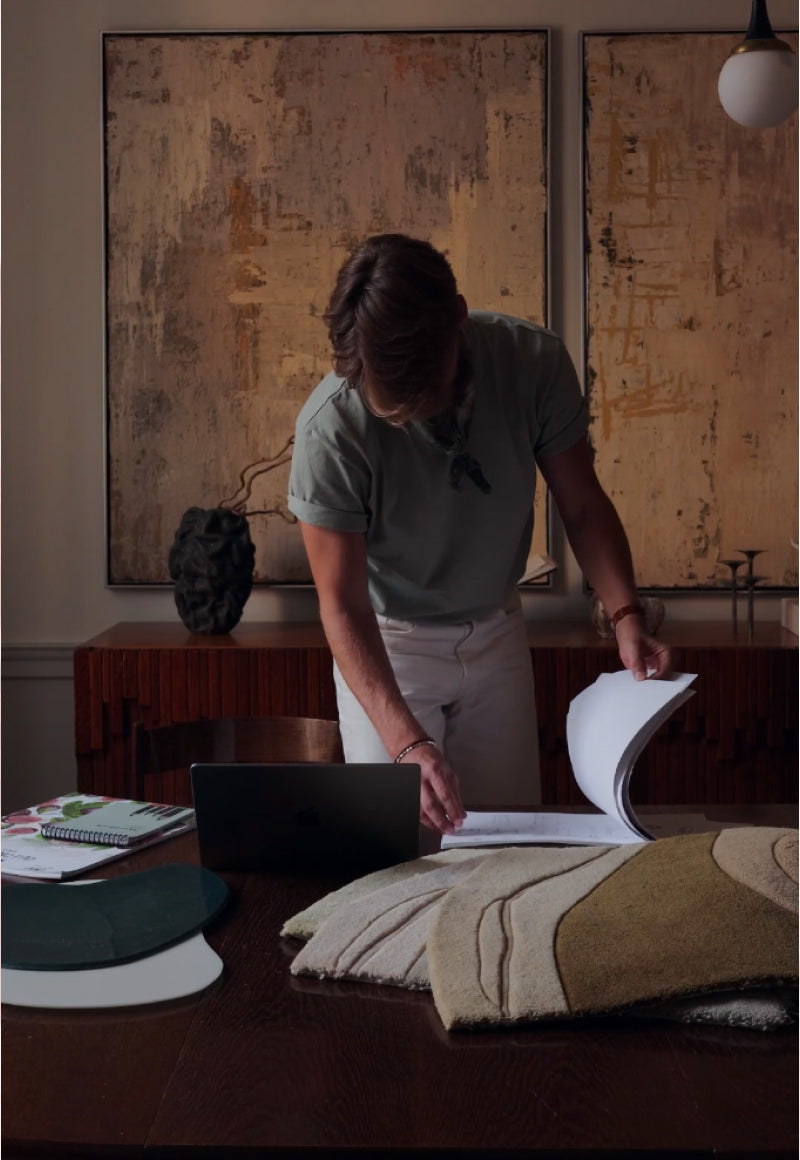
I would say my work is centred around aesthetics, to capture or create beauty in everyday life. My scope of work is rather broad but you could say it’s limited by the walls and ceiling of a home or public environment. It ranges from designing the smallest detail in a space, to crafting my own furniture or painting and sculpting, to designing a whole restaurant or a home. When designing I prefer being hands on in my process, building prototypes or the end products myself. It’s a rewarding process where you get to know the properties and limitations of a material or technique, or more correctly expressed, the hidden potential of its properties.
This is your first collaboration with LAYERED – what did you want to explore or develop?
I approach LAYERED because I had a problem with repeated wine staining on a carpet I had placed in a restaurant project. I wanted to design a good looking pattern that could “swallow” any spillage. To make a nice wine proof pattern in green turned out harder than planned. However, the relationship led to further discussions regarding carpet design in general and eventually led to the Lozza Rug collection.
Tell us more about the design behind the collection?
I’ve always been intrigued by form, both nature-made and man-made. One shape in itself can be beautiful but it is when you combine and find balance in several shapes...that´s when the music happens. What fascinates me most is that a composition can feel instinctively wrong or totally right. It just speaks to you. When I sketch, I play by intuition, drawing hundreds of lines. That feeling, when a piece or a layout finally hits that sweet spot of balance, is just so direct and rewarding.
As a trained economist math was a very prominent in my education. I’ve always been fascinated by how nature can be distilled into sequences, like Fibonacci or Pi. However, maths rigidity and norms, as well as those of the finance industries, made me feel unfree. I guess I needed to break free from those norms—and from the linear boundaries of a PowerPoint slide, which used to be my only creative outlet.
Today, I consciously avoid shapes that are easily measured or calculated. I’ve traded the search for mathematical precision for the beauty of imperfection.
“The strict frameworks of mathematics and the financial world eventually left me feeling constrained. I wanted to break free.”
Do the names of the collection mean anything special to you?
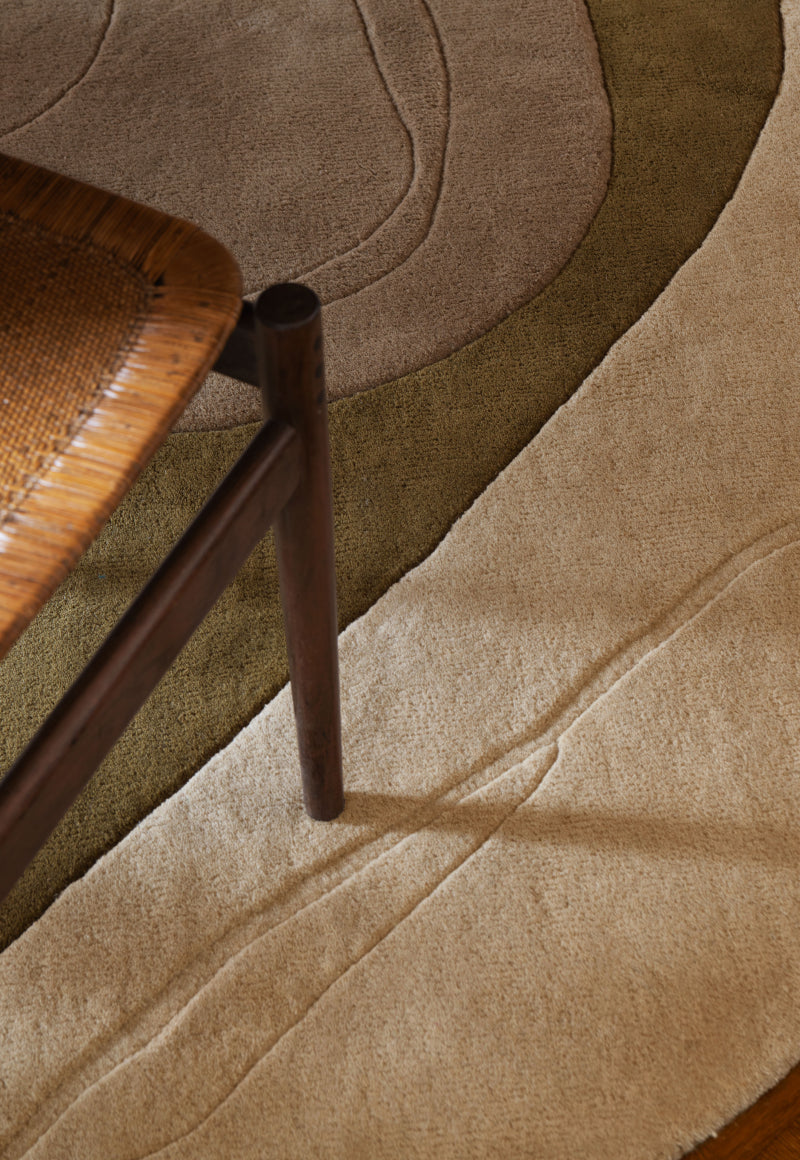
Lozza comes from the Italian word ‘tavolozza’ which means artist palette. It’s a nod to both the silhouette of the rug and its color blocks, which are designed to ‘blend’ an interior much like a painter mixes pigments. Painting is very close to my heart, so the name feels personal, even if I rarely use a physical palette myself. It’s also a tribute to my love for Italy and Italian mid-century design—a world I draw constant inspiration from and return to as often as I can.
How should you think when decorating a room with a rug in a shape other than rectangular?
The organic form allows for more freedom in placing furniture, making the room feel more versatile and interesting. It creates natural passage ways; for example, you can place lounge chairs asymmetrically, on or half off the rug, without it looking misplaced. It reinforces harmony if you choose other organic-shaped furnishings, but it also adds a softening contrast and balance if your furniture is more rigid and symmetrical."
The concept of “layering” is central to us – how do you interpret layering in your own work and in this collaboration?
Layering is the very foundation of the Lozza design, with its overlapping shapes. But layering is also what you do when composing an interior. One layer is color, one is material; then you have form, volume, and lighting.
All these elements need to complement one another to add depth and intrigue to the space. When layered correctly, the sum of the parts becomes greater than each individual item on its own. The Lozza rug is designed to help achieve exactly that.
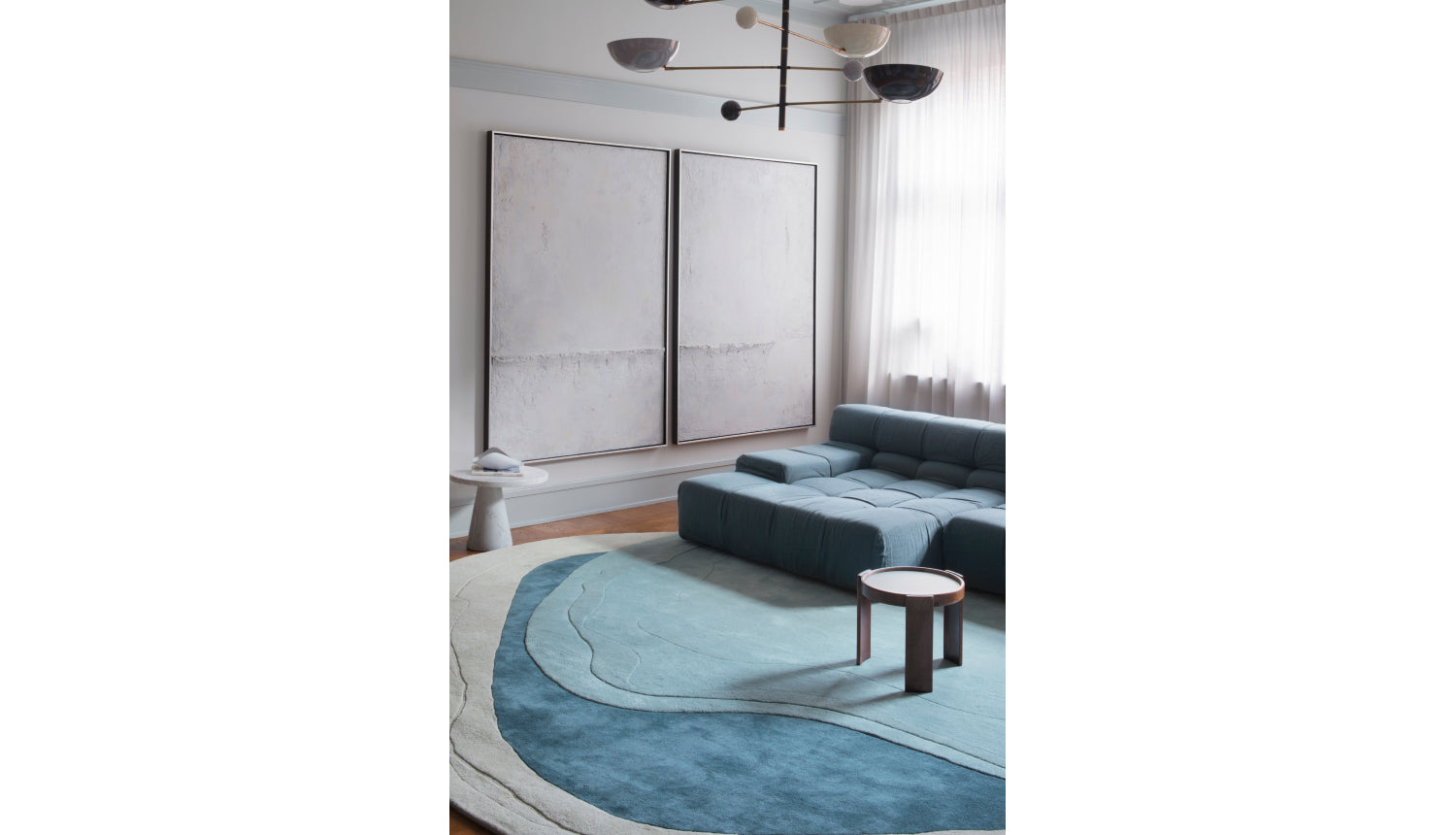
Lozza, Teal, Wool Rug.